
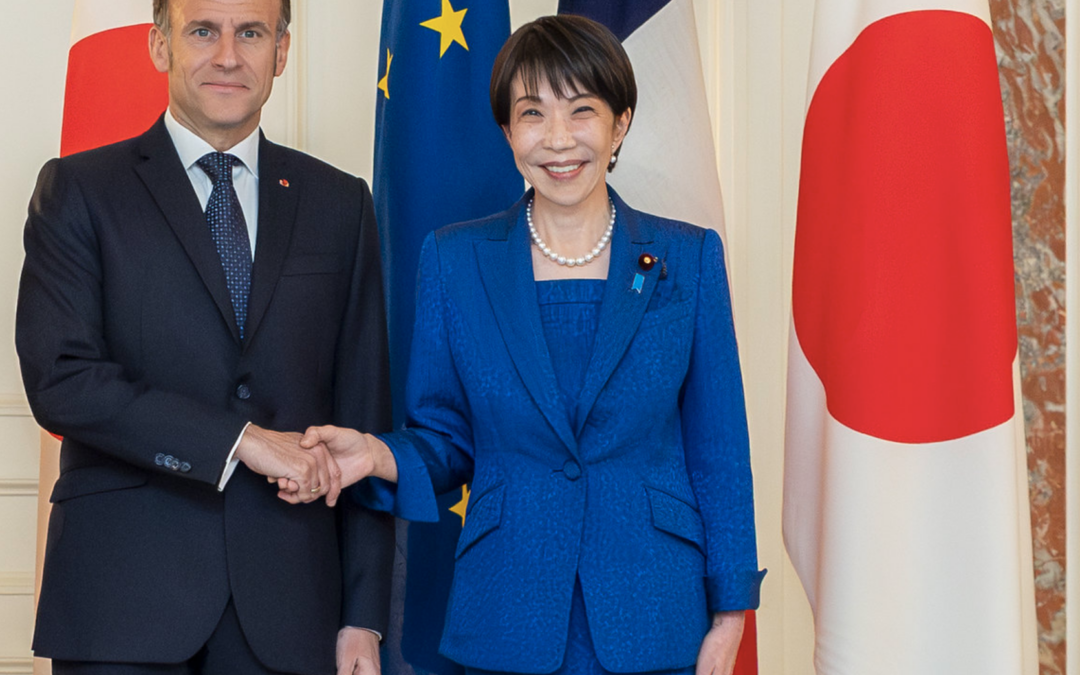
Franco-Japanese Nuclear Declaration
What the Franco-Japanese Nuclear Declaration Reveals
1 April 2026. On the sidelinesof President Emmanuel Macron’s state visit to Tokyo, the Élysée published a joint Franco-Japanese declaration on cooperation in civilian nuclear energy. Existing reactors, fuel cycle, next-generation reactors, fusion: the text is technical, precise, ambitious.
This document deserves closer attention — and not only for its energy content.
An agreement that was far from self-evident
Japan is the only country in the world to have experienced two atomic bombings. Hiroshima, 6 August 1945. Nagasaki, 9 August. That history did not settle into archives. It crossed generations, shaped political debate, and left a lasting mark on Japanese collective memory and culture.
Then came Fukushima, 11 March 2011 — a level-7 nuclear disaster on the international scale, which led to the progressive shutdown of nearly all Japanese reactors and a fundamental questioning of national energy policy.
It is against this backdrop that Prime Minister Shigeru Ishiba’s government adopted, in February 2025, Japan’s 7th Strategic Energy Plan — which explicitly reintegrates nuclear power into the national energy mix, in the name of energy security within an unstable geopolitical environment. A major policy reversal, openly assumed, which has not erased the domestic debate.
Signing a civilian nuclear cooperation declaration with Japan in 2026 means operating within that space.
What this changes in a commercial relationship
Companies that work — or seek to work — with Japanese players in sectors adjacent to energy, process industries, or high-precision equipment are not entering a standardised transaction. They are entering organisations where this kind of context can bear on stated priorities, on what topics can be raised in a meeting, on the pace of decisions, on the nature of questions asked.
This is not a generalisation about “Japanese culture”. It is a reality specific to each organisation, each counterpart, each moment in the relationship — one that requires reading, not assuming.
The Franco-Japanese declaration on civilian nuclear energy covers very concrete commitments: operation of existing reactors, on-site human resource development, support for first-access countries in Europe and the Indo-Pacific, strengthening of supply chains. Behind these commitments: markets, calls for tender, industrial partnerships to be built between French and Japanese companies.
A window, not a guarantee
The diplomatic context is favourable. The Franco-Japanese relationship rests on a solid framework — the exceptional partnership and its 2023–2027 roadmap — and President Macron’s visit gives it additional momentum. For French industrial companies, this is a real window of opportunity.
What partly determines whether that window produces concrete results is the quality of the approach strategy: knowledge of the key players, understanding of decision-making processes, the ability to invest in the long-term construction of a trust-based relationship. And a clear reading of what you are stepping into — neither naïve nor over-interpreted.
Franco-Japanese civilian nuclear cooperation illustrates, at the level of states, what every serious commercial relationship requires at its own level: genuine attention to the context in which your counterpart from another culture operates, before any discussion of the agreement to be reached.
© Presidency of the French Republic
Sources: Élysée.fr, Joint Franco-Japanese Declaration on Cooperation in the Field of Civil Nuclear Energy, 1 April 2026. Japan’s 7th Strategic Energy Plan, adopted on 18 February 2025 — referenced in the joint declaration. IRIS / Marianne Peron-Doise, Emmanuel Macron’s Visit to Tokyo and Seoul, 31 March 2026.