
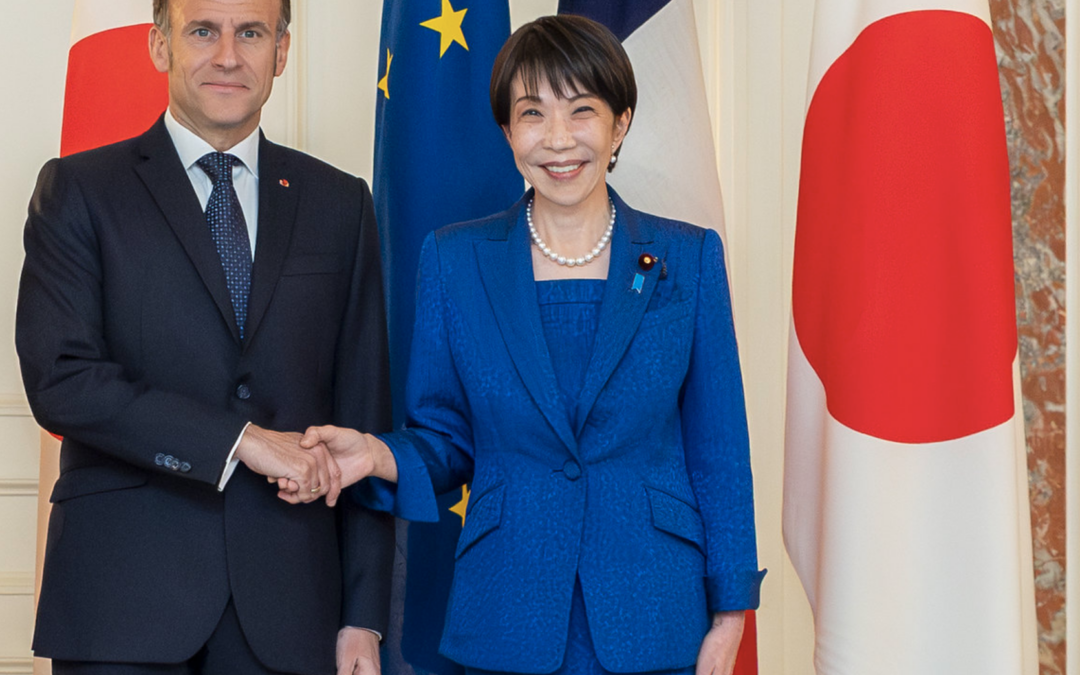
Photo : Elysee.fr
Franco-Japanese Nuclear Declaration
What the Franco-Japanese Nuclear Declaration Reveals
1 April 2026. On the sidelinesof Presid
ent Emmanuel Macron’s state visit to Tokyo, the Élysée published a joint Franco-Japanese declaration on cooperation in civilian nuclear energy. Existing reactors, fuel cycle, next-generation reactors, fusion: the text is technical, precise, ambitious.
This document deserves closer attention — and not only for its energy content.
An agreement that was far from self-evident
Japan is the only country in the world to have experienced two atomic bombings. Hiroshima, 6 August 1945. Nagasaki, 9 August. That history did not settle into archives. It crossed generations, shaped political debate, and left a lasting mark on Japanese collective memory and culture.
Then came Fukushima, 11 March 2011 — a level-7 nuclear disaster on the international scale, which led to the progressive shutdown of nearly all Japanese reactors and a fundamental questioning of national energy policy.
It is against this backdrop that Prime Minister Shigeru Ishiba’s government adopted, in February 2025, Japan’s 7th Strategic Energy Plan — which explicitly reintegrates nuclear power into the national energy mix, in the name of energy security within an unstable geopolitical environment. A major policy reversal, openly assumed, which has not erased the domestic debate.
Signing a civilian nuclear cooperation declaration with Japan in 2026 means operating within that space.
What this changes in a commercial relationship
Companies that work — or seek to work — with Japanese players in sectors adjacent to energy, process industries, or high-precision equipment are not entering a standardised transaction. They are entering organisations where this kind of context can bear on stated priorities, on what topics can be raised in a meeting, on the pace of decisions, on the nature of questions asked.
This is not a generalization about “Japanese culture”. It is a reality specific to each organization, each counterpart, each moment in the relationship — one that requires reading, not assuming.
The Franco-Japanese declaration on civilian nuclear energy covers very concrete commitments: operation of existing reactors, on-site human resource development, support for first-access countries in Europe and the Indo-Pacific, strengthening of supply chains. Behind these commitments: markets, calls for tender, industrial partnerships to be built between French and Japanese companies.
A window, not a guarantee
Le contexte diplomatique est favorable. La relation franco-japonaise repose sur un cadre solide — le partenariat d’exception et sa feuille de route 2023-2027 — et la visite du Président Macron lui donne un élan supplémentaire. Pour les entreprises industrielles françaises, c’est une fenêtre réelle.
Ce qui détermine en partie si cette fenêtre produit des résultats concrets, c’est la qualité de la stratégie d’approche : connaissance des acteurs, compréhension des circuits de décision, capacité à s’inscrire dans le temps long d’une relation de confiance. Et une lecture précise de ce dans quoi on entre — ni naïve, ni surinterprétée.
What partly determines whether that window produces concrete results is the quality of the approach strategy: knowledge of the key players, understanding of decision-making processes, the ability to invest in the long-term construction of a trust-based relationship. And a clear reading of what you are stepping into — neither naïve nor over-interpreted.
© Presidency of the French Republic
Sources: Élysée.fr, Joint Franco-Japanese Declaration on Cooperation in the Field of Civil Nuclear Energy, 1 April 2026. Japan’s 7th Strategic Energy Plan, adopted on 18 February 2025 — referenced in the joint declaration. IRIS / Marianne Peron-Doise, Emmanuel Macron’s Visit to Tokyo and Seoul, 31 March 2026.